Complete 1-Stop Bhutan Tour Guide
Written by Greenhills Tour Travel Experts
10+ years experience in Northeast India tourism
Everything You Need to Know Before Visiting Bhutan
Visa rules, SDF fees, top places, 7-day itinerary, real costs, and insider tips — all in one complete guide for first-time travellers to the Land of the Thunder Dragon.
About This Guide
Why Bhutan Is Unlike Any Other Destination in the World
Bhutan does not advertise itself. It does not compete for tourists. It does not offer budget backpacker trails or all-inclusive beach resorts. What it offers instead is something far more rare — an ancient, living Himalayan kingdom that has chosen depth over volume, preservation over development, and happiness over growth.
This is the only country in the world that measures its national success using a Gross National Happiness index rather than GDP. It is the only country in South Asia that has remained carbon-negative, meaning it absorbs more carbon than it produces. Over 71% of its land is legally protected as forest. Traditional architecture is not just preserved — it is constitutionally required. Monks outnumber soldiers. Fortresses still serve as both government buildings and monasteries simultaneously.
And yet, for all its depth and complexity, planning a trip to Bhutan can feel confusing — especially when it comes to understanding the visa rules, the Sustainable Development Fee (SDF), the permit system, and how to actually get there. This guide cuts through all of that. Consider it your complete 1-stop Bhutan tour guide: everything you need, in one place, before you book a single flight.
Whether you are planning a quick 5-day Paro trip or a longer 12-day cross-country journey, this guide gives you an accurate, honest picture of what Bhutan costs, what it offers, and how to experience it properly.
What This Bhutan Tour Guide Covers
01 Visa & Entry Requirements
02 Sustainable Development Fee
03 Best Time to Visit Bhutan
04 Top Places to Visit
05 7-Day Bhutan Itinerary
06 How to Reach Bhutan
07 Essential Travel Tips
08 Frequently Asked Questions
Section 01
Visa & Entry Requirements for Bhutan
Bhutan does not issue visas on arrival. All tourists — except Indian, Bangladeshi, and Maldivian nationals — must obtain a visa before they travel. The process is entirely managed through licensed Bhutanese tour operators, which means you cannot enter Bhutan as an independent traveller without pre-booking a package through an approved operator.
Bhutan Visa at a Glance
Key visa details for international and SAARC visitors planning a Bhutan tour.
Indian nationals must carry a valid passport or Voter ID card. Pakistani nationals are not currently permitted to enter Bhutan for tourism. All visitors must be part of a pre-arranged package through a licensed Bhutanese tour operator or an international partner agency.
The visa approval is sent electronically. When you land at Paro Airport, your visa stamp is applied on arrival after the operator’s authorisation is confirmed. The entire process is handled through the Tourism Council of Bhutan’s online portal, and your tour operator manages this on your behalf once you book.
For Indian travellers specifically, a permit called an “Entry Permit” is issued at the border or airport. This permit must be carried at all times and shown at internal checkpoints as you move between districts. Additional area permits are required for restricted zones such as Haa Valley, Wangdue, and the eastern districts.
Section 02
Understanding the Sustainable Development Fee (SDF)
The Sustainable Development Fee is perhaps the most misunderstood part of planning a Bhutan tour. Many first-time visitors confuse it with a visa fee or mistake it for a hotel tax. It is neither. The SDF is a mandatory per-night levy charged on every visitor, and it directly funds Bhutan’s healthcare, education, and environmental conservation programmes.
Think of it as the price Bhutan charges for its own preservation — and when you see how immaculately the country maintains its forests, monuments, and culture, that cost makes complete sense.
USD $100 per person per night. This applies to all tourists from outside India, Bangladesh, and the Maldives. A 5-night trip for 2 people means USD $1,000 in SDF alone.
INR ₹1,200 per person per night. For Indian travellers, a 5-night trip for 2 people means ₹12,000 in SDF — a significantly more affordable rate.
Children under 5 years of age are exempt from SDF. Children aged 6–12 pay 50% of the adult SDF rate. Over 13 pays full adult rate.
The SDF covers a government-certified guide, basic accommodation support, and a contribution to Bhutan’s conservation and welfare programmes.
The SDF is paid upfront through your tour operator before you arrive. It is non-negotiable and non-refundable. What it does guarantee, however, is that Bhutan remains one of the most pristine, unhurried, and culturally intact travel destinations anywhere in Asia.
Section 03
Best Time to Visit Bhutan — Season by Season
Bhutan has four distinct seasons, and each offers a different kind of experience. The good news is that unlike many other Himalayan destinations, Bhutan is broadly visitable year-round — even the monsoon season has its own quiet, lush appeal.
The most popular and visually stunning season. Rhododendrons and magnolias bloom across hillsides in bursts of pink, red, and white. The Paro Tshechu festival falls in spring. Weather is mild and mountain views are crisp and clear. Best overall time to visit.
Monsoon season brings heavy rains, landslides on mountain roads, and lush, deeply green landscapes. Tourism drops, so you get a much quieter experience. Many trekking trails are inaccessible but valley destinations remain open. Good for budget-conscious travellers.
Second peak season. The monsoon has cleared and the air is exceptionally clean. Mountain views are the sharpest of the year — ideal for photography. The Thimphu Tshechu festival falls in October. Warm days and cool nights. Highly recommended.
Cold, especially at higher altitudes. Snow closes many mountain passes. However, the lower valleys like Punakha are warm and pleasant, and black-necked cranes migrate to Phobjikha Valley in winter — a rare wildlife spectacle unique to this season.
Section 04
Top Places to Visit on Your Bhutan Tour
Bhutan is compact in geography but extraordinary in depth. Most visitors concentrate their time across three main valleys — Paro, Thimphu, and Punakha — which together contain the country’s most iconic sights. Here is what you need to know about each major destination.
Paro Taktsang — The Tiger’s Nest Monastery
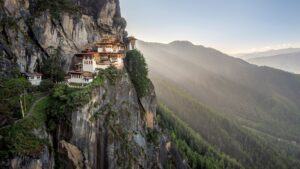
No single image defines Bhutan more completely than the Tiger’s Nest Monastery, perched on a sheer granite cliff 900 metres above the Paro Valley floor. This sacred site — built in 1692 around a cave where Guru Rinpoche is believed to have meditated in the 8th century — is both the most iconic and most challenging of all Bhutan’s attractions.
The hike to the monastery takes 2–3 hours one way and climbs through pine forests scented with incense smoke. At the halfway point, a tea house offers perhaps the most spectacular view in the entire country. Up close, the monastery itself is a series of lhakhangs (temples) connected by stairways carved into the rock. It is absolutely worth every step of the climb.
Thimphu — The Capital That Feels Nothing Like One
Thimphu is the only capital city in the world without a single traffic light — roundabouts and police hand signals manage the flow instead. It is a city where traditional Bhutanese architecture is constitutionally required for all new buildings, where the king’s palace sits without any visible security fence, and where the national memorial chorten sees thousands of locals circumambulating it every single morning.
Key highlights include the Tashichho Dzong (the seat of the royal government), the Folk Heritage Museum, the National Textile Museum, Motithang Takin Preserve, and the Buddha Dordenma — a 51-metre golden Buddha statue overlooking the entire valley. Plan at least two full days here.
Punakha — The Ancient Capital & Its Magnificent Dzong
Punakha was Bhutan’s capital until 1955 and remains one of the most beautiful valleys in the entire country. At just 1,200 metres, it is warmer than Thimphu and Paro, and the valley floor is covered in terraced rice paddies that glow golden during the harvest months of October and November.
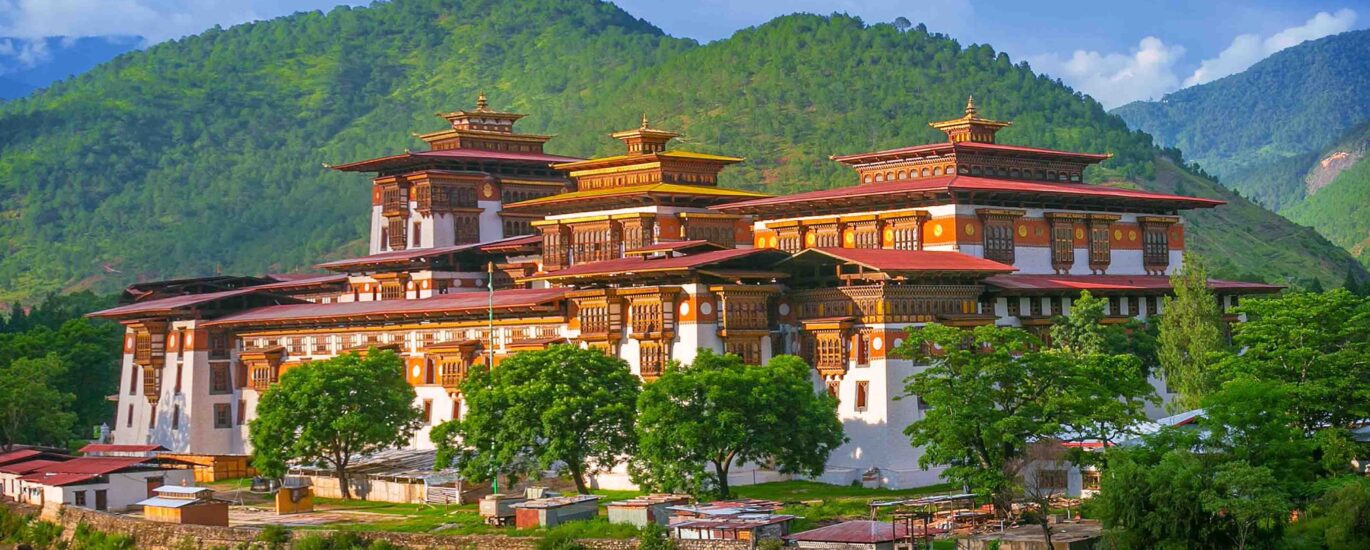
The Punakha Dzong — built at the confluence of the Pho Chhu and Mo Chhu rivers — is arguably the most architecturally stunning building in Bhutan. The dzong served as the seat of government for centuries and still hosts the body of the Divine Madman, Drukpa Kunley, as well as some of the country’s most sacred religious relics. A suspension bridge leads to its main entrance, making even the approach to it feel cinematic.
Tshechu Festivals — The Soul of Bhutanese Culture
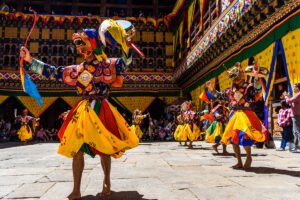
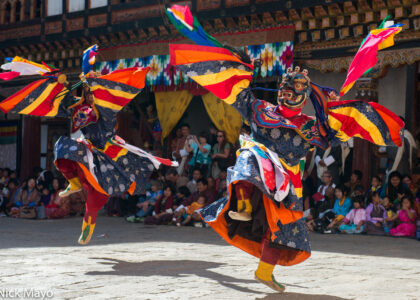
If your visit coincides with a Tshechu — Bhutan’s traditional masked dance festival — rearrange every other plan to attend. Tshechus are held in different districts throughout the year, with the Paro Tshechu (March/April) and Thimphu Tshechu (September/October) being the most celebrated.
The festivals last 3–5 days and feature Cham dances — elaborate masked performances depicting Buddhist teachings, the lives of saints, and stories of good triumphing over evil. Monks in ornate silk costumes and heavy wooden masks perform in the dzong courtyards while thousands of Bhutanese gather in traditional dress. Attending a Tshechu is not a tourist spectacle — it is a living religious ceremony that the entire community participates in together.
Section 05
Recommended 7-Day Bhutan Tour Itinerary
Seven days is the sweet spot for a first-time Bhutan tour. It allows you to cover the three main valleys without rushing, experience at least one full-day hike, and absorb the pace of Bhutanese life properly. Here is a day-by-day itinerary that works well for most visitors.
Paro Airport is one of the most dramatic landings in aviation — mountains rise on all sides and pilots must navigate tight valley approaches. After arrival and immigration, your guide will meet you, assist with your entry permit, and transfer you to your hotel. Spend the afternoon acclimatising with a short walk to the Rinpung Dzong (the fortress guarding Paro town) and the National Museum of Bhutan. The evening is ideal for exploring Paro’s small but charming main street.
Start early — by 7:30 AM at the trailhead if possible — to beat the midday heat and arrive with the morning light still on the monastery face. The hike takes 2–3 hours up and 1.5–2 hours back down. Take your time, photograph from the prayer flag viewpoint midway, and spend 45 minutes exploring the inner temples at the top. Pack a light lunch or eat at the halfway tea house on your descent. This is a full-day experience and the physical and emotional highlight of most Bhutan tours.
Drive to Thimphu (1.5 hours) and spend the day covering the capital’s key highlights: the Tashichho Dzong, the National Memorial Chorten, the Motithang Takin Preserve, the National Textile Museum, and the Buddha Dordenma statue for panoramic valley views. In the evening, walk through Thimphu’s lively Clock Tower Square area and try Bhutanese cuisine — especially Ema Datshi, the national dish of chilli and cheese — at a local restaurant.
The drive from Thimphu to Punakha crosses the Dochula Pass at 3,050 metres — home to 108 memorial chortens built in honour of Bhutanese soldiers. On a clear day, you can see over 20 Himalayan peaks from this point. Continue down into the warm Punakha Valley and spend the afternoon at the magnificent Punakha Dzong. If time allows, walk the Punakha suspension bridge and explore the riverside monastery of Khamsum Yulley Namgyal Chorten (a 45-minute hike up a ridge).
Morning is free to explore the Punakha Valley at a slower pace. Visit the Chimi Lhakhang — the Fertility Temple of the Divine Madman — reached via a short walk through rice paddies. This temple is famous across Bhutan for its prayers blessing childless couples, and the phallus paintings covering local farmhouse walls (a tradition of warding off evil) make for one of the most unexpectedly striking visual experiences in Bhutan. In the afternoon, drive back towards Thimphu or continue your route depending on your extended itinerary.
Use your second Thimphu day to go deeper. Visit the Folk Heritage Museum (a beautifully restored traditional farmhouse) and the National Library with its collection of ancient Buddhist manuscripts. Walk through the weekend market (Centenary Farmers Market) to see the produce, crafts, and daily life of Thimphu’s residents. In the afternoon, visit a local school or monastery if your guide can arrange it — interacting with Bhutanese people is consistently rated by visitors as the most memorable part of any Bhutan tour.
Most flights out of Paro depart in the late morning or early afternoon. Use your final morning for a quiet walk around Paro town, a last cup of butter tea, or a visit to any nearby site you may have missed on Day 1. Paro has several fine craft shops where you can buy authentic Bhutanese textiles, thangka paintings, and hand-carved wooden items as souvenirs. Your guide will transfer you to the airport — and the Bhutanese tradition is for guides to stay until you check in.
Section 06
How to Reach Bhutan — Your Entry Options
Bhutan has exactly one international airport — Paro — and only two airlines currently serve it: Druk Air (Bhutan’s national carrier) and Bhutan Airlines. This limited connectivity is entirely by design. Bhutan controls its tourism volume, and limited air access is part of that strategy.
By Air — Flying into Paro Airport
Paro International Airport is served by direct flights from Delhi, Mumbai, Kolkata, Kathmandu, Bangkok, Singapore, and a handful of other Asian cities. Flights from Kolkata to Paro take just 50 minutes — making it one of the most convenient international routes from India. From Delhi, the flight time is approximately 2 hours. Paro’s approach is consistently listed among the world’s most challenging for pilots, but the landing experience is visually extraordinary for passengers.
By Road — Land Border Crossings
Three official land crossings connect Bhutan to India: Phuentsholing (West Bengal/Bhutan border — the most popular), Gelephu (Assam), and Samdrup Jongkhar (Assam, for eastern Bhutan access). Of these, Phuentsholing is the most commonly used by Indian tourists. The town sits right on the border, and a permit is issued here at the Bhutan Gate. From Phuentsholing, it is a 5-hour drive up to Thimphu via mountain roads.
Booking Through a Licensed Tour Operator
Whether you fly or cross by road, all international tourists (and Indian nationals travelling beyond Phuentsholing) must have their trip arranged through a licensed Bhutanese tour operator. The Tourism Council of Bhutan maintains an updated list of approved operators on its official website. Your operator handles your visa, SDF payment, guide assignment, accommodation, and internal permits — so choosing a reliable operator is the single most important decision in planning your Bhutan tour.
Section 07
Essential Tips Before You Travel to Bhutan
After three separate visits to Bhutan across different seasons, here are the tips that genuinely make a difference to your experience on the ground.
Even in spring and autumn, Bhutan’s mountain temperatures fluctuate dramatically between day and night. A warm afternoon in Thimphu can be followed by a near-freezing evening. Always carry a fleece or light down jacket, even in summer.
Bhutanese people are generally warm and welcoming, but photographing monks, locals, or people at prayer without permission is disrespectful. Always ask, and accept a no gracefully. Most people are happy to be photographed if approached with courtesy.
The Tiger’s Nest hike is on uneven stone paths for 3+ hours. New boots will ruin the experience. Wear well-broken-in trail shoes or trekking boots with ankle support. Trekking poles are available for hire at the trailhead and are genuinely useful on the descent.
ATMs are available in Thimphu and Paro but can be unreliable. Indian rupees are accepted in most Bhutanese shops and restaurants. International travellers should carry USD cash for any top-up expenses. Credit cards are accepted in larger hotels but not in small restaurants or shops.
This is non-negotiable at dzongs, monasteries, and temples. Slip-on shoes make the process significantly easier. Many dzongs also require you to dress modestly — no shorts or sleeveless tops inside religious precincts.
Bhutan Telecom and TashiCell both offer tourist SIM cards at Paro Airport. A 7-day data SIM costs around Nu 500 (approximately ₹500 or USD $6). Coverage is good in all main valleys and towns, though it disappears on mountain roads between passes.
Section 08
Frequently Asked Questions — Bhutan Tour Guide
Can Indians travel to Bhutan without a visa?
Yes. Indian nationals do not require a visa to enter Bhutan. However, they do need a valid passport or Indian Voter ID card, and they must obtain an Entry Permit at the border (Phuentsholing, Gelephu, or Samdrup Jongkhar) or at Paro Airport. This permit is free and issued on arrival. Indian travellers do, however, need to pay the SAARC SDF of ₹1,200 per person per night, which applies from 2023 onwards.
Is it possible to travel independently in Bhutan without a tour guide?
For international tourists, independent travel in Bhutan is not permitted — a licensed guide is mandatory. For Indian nationals, travel within Phuentsholing town does not require a guide, but to travel beyond the border town and into the interior of Bhutan (including Thimphu, Paro, and Punakha), an approved Bhutanese operator and guide arrangement is required for group travel. Solo Indian travellers with a valid ID can technically travel independently to the main valley towns, but organised tours remain the recommended and most hassle-free option.
How many days is ideal for a first Bhutan tour?
A minimum of 5 days is needed to cover Paro (Tiger’s Nest) and Thimphu properly. Seven days is the recommended minimum for first-time visitors as it allows for the Paro–Thimphu–Punakha triangle, which covers the country’s three most significant destinations without feeling rushed. If your budget allows and you are interested in trekking or eastern Bhutan, 10–14 days gives a much more complete picture of the country.
What currency is used in Bhutan, and can I use Indian rupees?
Bhutan’s official currency is the Ngultrum (Nu), which is pegged 1:1 to the Indian Rupee. Indian rupees (INR) are accepted virtually everywhere in Bhutan — shops, restaurants, taxis, and markets. The only denomination of Indian note not accepted in Bhutan is the ₹2,000 note. International visitors can use USD or EUR at exchange counters in Thimphu and Paro, or withdraw Ngultrum from ATMs using international debit/credit cards.
Is Bhutan suitable for elderly travellers or people with limited mobility?
Bhutan is absolutely manageable for elderly travellers with some adjustments. The Tiger’s Nest hike can be replaced with the viewpoint below (reachable by horse or a shorter walk) which still provides outstanding views of the monastery. Punakha Dzong involves some stairs but is otherwise accessible. Thimphu is a flat, walkable city. The main challenge is the high altitude in certain areas — travellers with heart or respiratory conditions should consult a doctor before visiting Paro (2,280m) and higher altitude passes.
What is the food like in Bhutan, and is vegetarian food available?
Bhutanese cuisine is flavourful and rice-centred with a heavy use of chilli — Bhutanese people consume some of the highest quantities of chilli per capita in Asia. The national dish Ema Datshi (chilli and cheese stew) is delicious and largely vegetarian. Vegan options are widely available since much local cooking uses butter and cheese rather than meat. Hotels catering to tourists will always have vegetarian and mild food options. Most restaurants in Thimphu and Paro also serve Indian food (dal, roti, rice dishes), so dietary concerns are manageable.
Bhutan Rewards the Traveller Who Is Truly Ready for It
This complete 1-stop Bhutan tour guide has covered every practical angle of planning your visit — visa, SDF, best timing, top places, itinerary, real costs, how to get there, and what to watch out for on the ground. What it cannot fully prepare you for is how the country actually feels when you are inside it.
Bhutan has a quality that is genuinely hard to describe. It is the only place where you can watch a monk use a smartphone while sitting below a 600-year-old fresco. Where a farmer will stop everything to point you in the right direction for twenty minutes, the mountains feel close enough to touch, at the end of a 5-hour hike, the doors of an ancient monastery creak open and the smell of juniper incense fills the cold Himalayan air.
The SDF, the guide requirement, the limited flights, the permit system — all of it exists to protect this. And when you are standing at Tiger’s Nest at sunrise with the entire Paro Valley silent below you, you will understand exactly why Bhutan has chosen to protect itself the way it has.
Plan carefully, choose your operator well, go with an open schedule, and leave Bhutan to do the rest. It always delivers.