
North Sikkim — A Complete Season-by-Season Guide
📋 What’s Inside This Guide
- Why Timing Your Trip to North Sikkim Matters
- Quick Season Overview — At a Glance
- Spring (March to May): The Bloom Season
- Summer (June): The Sweet Spot Before Monsoon
- Monsoon (July–August): Handle With Care
- Autumn (September–November): Clear Skies Return
- Winter (December–February): A Snowy Frontier
- Month-by-Month Quick Reference Table
- Top Places in North Sikkim & When to Visit Each
- Permits You Need — What Has Changed in 2025–26
- Frequently Asked Questions
There is no place in India quite like North Sikkim.
Imagine standing beside a glacier-fed lake so high that the air itself feels thin and sacred. Picture valleys where entire hillsides blush pink with rhododendrons every spring, as if the mountains are showing off. Then picture villages so wrapped in silence that the only sounds reaching your ears are the wind moving through pine trees, a river rushing somewhere below, and the low, unhurried groan of a yak on a distant slope.
But here is the honest truth — this region rewards those who visit at the right time and punishes those who don’t. Roads wash away in the monsoon. Passes freeze shut in deep winter. The difference between visiting in April and visiting in August can mean the difference between the trip of your life and a frustrating two-day wait in Gangtok. This guide is written by someone who has made that mistake — and who has also seen North Sikkim at its absolute best. Read it carefully before you book that flight.
Quick Season Overview — At a Glance
Before going into depth on each season, here is a simple overview of how North Sikkim behaves through the year. Every season has a different personality. The key is matching your expectations to the season you choose.
Spring (March to May): The Season North Sikkim Was Made For
If you ask any experienced Sikkim traveller which month they keep coming back to, the answer almost always includes April or May. Spring in North Sikkim is not just pleasant — it is genuinely spectacular. The entire district wakes up from the cold months and puts on a show.
The Yumthang Valley, known locally as the Valley of Flowers, earns that name entirely during spring. Over 24 species of rhododendron erupt into colour across the hillsides, turning what was a brown alpine valley into a sea of red, pink, white, and purple. Temperatures in the valley sit around 12°C to 22°C during the day — cool enough for light layers but warm enough to walk around comfortably. At night, you will still feel the mountain cold, so carrying a warm jacket is a good idea.
Roads are fully open in spring and well-maintained after the winter freeze. Permits are being processed smoothly. Tour operators are in peak mode, which means you get the most support, the most variety in packages, and the best availability in guesthouses across Lachen and Lachung. This is also a wonderful time to visit Lachung Monastery, which celebrates the Losar festival in late February and early March, though the colour spills into the spring months.
Book your North Sikkim package at least 3–4 weeks in advance if you are travelling in April or May. These are the most popular months and shared jeep packages sell out quickly. The Yumthang rhododendron bloom typically peaks between mid-April and mid-May, so that is the sweet spot to target.
One thing to keep in mind is that spring — especially May — draws the largest number of domestic tourists. The roads from Gangtok to Mangan can get busy with convoys of jeeps heading north. If you prefer a quieter experience, March and early April offer the same beauty with significantly fewer people sharing the view.
Early Summer (June): The Quiet Window Before the Rain Arrives
June occupies a strange and interesting place in the North Sikkim calendar. The monsoon has technically begun in other parts of India and even in South Sikkim, but the north — being at higher altitude and receiving rainfall from a different pattern — stays relatively dry and clear for much of the month. This makes early June a genuinely good time to visit, especially if you missed the spring rush.
Temperatures in June are slightly warmer than spring — ranging from around 15°C to 25°C in the valleys — making it comfortable for sightseeing and moderate walking. The flowers from spring are fading but the landscape still looks lush and green. Gurudongmar Lake is fully accessible and at its most vivid blue against the now-clear summer skies. Zero Point, the high-altitude last accessible civilian point at around 15,300 feet near Lachung, also remains open in June.
While early June is generally safe, rainfall starts increasing significantly after mid-June. If your travel dates fall in the third or fourth week of June, keep a very close eye on weather forecasts and be prepared for possible road disruptions. Travelling with a registered tour operator during this period is especially important.
Visitor numbers drop noticeably in June compared to April–May, which translates to easier permits, more accommodation choices, and a more peaceful experience at the lakes and valleys. For budget-conscious travellers, June also often brings slightly lower package prices than peak spring months.
Monsoon (July and August): Beautiful, But Genuinely Risky
Let’s be straight about this. July and August in North Sikkim are not recommended for most travellers — particularly those visiting for the first time. The monsoon hits the hills hard. Landslides are not an occasional inconvenience here; they are a regular, sometimes daily occurrence on the mountain roads between Mangan, Lachen, and Lachung. Entire stretches of road can disappear overnight. The Teesta River, which runs through the heart of North Sikkim, swells dramatically and the surrounding hills turn into cascading waterfalls — which is undeniably beautiful, but also signals just how much water is falling on these mountains.
Temperatures during monsoon hover around 16°C to 22°C, which is not uncomfortable, and the landscape has a raw, wild beauty that some experienced travellers do specifically seek out. Mist covers the mountaintops every morning. The valleys look impossibly green. But none of that scenic drama matters much if you are stuck for two days in Chungthang waiting for a bulldozer to clear a road.
That said, one interesting fact about North Sikkim’s monsoon is that it receives less intense rainfall than the southern and eastern parts of the state. July sees the heaviest rainfall but even then, the north gets lighter showers compared to Gangtok. If you are an experienced mountain traveller, know the risks, carry flexible dates, and travel only with a reliable local operator, a monsoon visit can be deeply rewarding. For everyone else, it is worth waiting for September.
Autumn (September to November): The Second Peak Season — And Some Would Say the Best
Many experienced Himalayan travellers will tell you that September and October are their favourite months in the entire North Sikkim calendar. And honestly, having experienced both spring and autumn here, this argument is very hard to refute.
The rains clear out by mid-September and the air that follows is the cleanest, sharpest, and most transparent you will find all year. The mountains — including Kanchenjunga, the world’s third-highest peak — appear with a clarity during autumn that simply does not exist in any other season. Every morning feels like someone has cleaned the sky overnight. The views from Lachung village, from the ridge above Lachen, and certainly from the shores of Gurudongmar Lake are nothing short of breath-taking in October.
Autumn also happens to be festival season. Dussehra and Diwali (or Tihar, the Nepali version celebrated across Sikkim) fall in October and November. In village monasteries, Lhabab Duchen — the Buddhist celebration of Buddha’s descent from Heaven — is observed with traditional mask dances and community gatherings. Visiting North Sikkim during one of these festivals gives you a cultural depth that the shoulder seasons simply cannot offer.
The temperature in autumn ranges from about 10°C to 20°C in the lower valleys, dropping significantly at altitude. By November, nighttime temperatures at Lachen and Lachung can approach freezing, so warm layering is essential. But the days remain sunny, dry, and clear — perfect for the long drives and lake visits that define the North Sikkim itinerary.
October is widely considered the best month for mountain photography in all of Sikkim. The post-monsoon clarity means you can often see Kanchenjunga without a single cloud obscuring the peak. If you carry a camera, this is your month.
Winter (December to February): A Snow World for the Brave and Prepared
Winter in North Sikkim is a completely different journey. The crowds disappear. The roads thin out. And the landscape transforms into something you might expect to see in photographs from Siberia or the high Tibetan plateau. Everything is white. The mountains, the valley floors, the stone paths of Lachung — all buried under varying depths of snow.
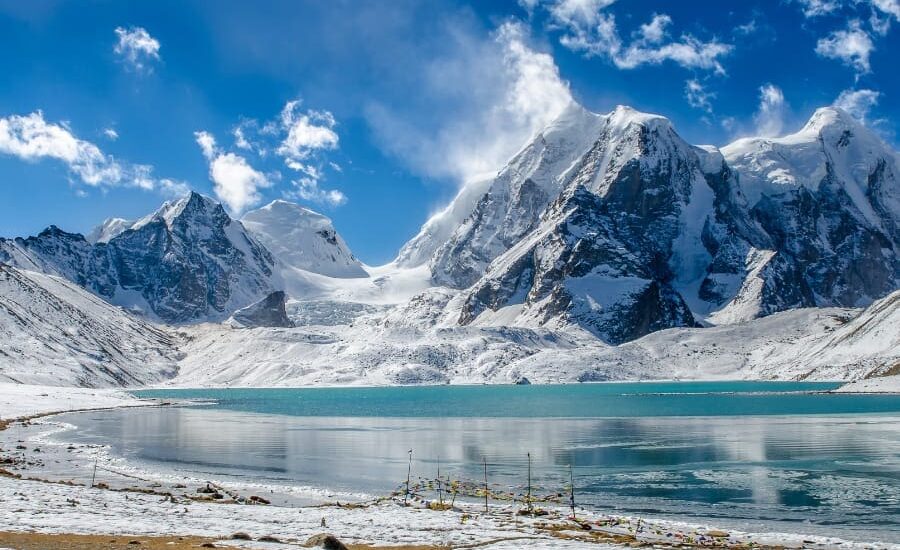
Gurudongmar Lake, which sits at 17,800 feet above sea level, becomes almost completely frozen in winter, with only a small patch of water remaining even at minus 20°C. This phenomenon has a spiritual dimension — locals believe this patch of water never freezes because of a blessing by Guru Padmasambhava, for whom the lake is named. Seeing the lake in winter, surrounded by ice and snow with the silence of high altitude pressing in from every direction, is genuinely unforgettable.
However, winter comes with real practical challenges that cannot be glossed over. Road closures due to heavy snowfall are frequent and unpredictable. The route to Gurudongmar Lake from Lachen can become impassable for days at a time. Flights into Bagdogra (the nearest major airport) face delays due to fog on the plains. Temperatures at Lachung and Lachen regularly drop below -5°C at night, and at altitude, the cold is genuinely severe.
Despite this, December does have a sweet spot — specifically the Mangan Music Festival, held every December around the 12th to 14th, which draws performers and visitors to the North Sikkim district headquarters. The Mask Dance at the Lachung Monastery in early December is also one of the most visually striking cultural events in the entire region. If you time your visit around these events and travel with an experienced operator who knows current road conditions, December can be magical.
Children below 5 years and seniors above 65 are officially not permitted to visit high-altitude sites like Gurudongmar Lake at any time of year — and this restriction is enforced at checkposts. In winter, altitude sickness risks increase for all visitors because the cold air at 17,000+ feet is far harder on the body. Do not attempt Gurudongmar in January or February without proper acclimatisation and medical preparation.
Month-by-Month Quick Reference Table
Use this table to quickly match your travel window to what you can expect in North Sikkim. The rating reflects overall suitability for the average traveller.
| Month | Temperature Range | Road Access | Best Activity | Rating |
|---|---|---|---|---|
| January | -5°C to 8°C | ⚠ Risky — heavy snow | Snow experience, cultural festivals | |
| February | -2°C to 10°C | ⚠ Risky — improving | Losar festival, snow photography | |
| March | 5°C to 16°C | ✓ Good — roads clearing | Early blooms, fewer crowds | |
| April | 10°C to 20°C | ✓ Excellent | Rhododendrons, sightseeing, trekking | |
| May | 12°C to 22°C | ✓ Excellent — busy | Peak bloom, all attractions open | |
| June | 14°C to 24°C | ✓ Mostly good | Lakes, valleys, budget travel | |
| July | 16°C to 22°C | ✗ Difficult — landslides | Waterfalls, rain lovers only | |
| August | 16°C to 22°C | ✗ Difficult — landslides | Greenery, photography from lodge | |
| September | 12°C to 20°C | ✓ Good — improving fast | Nature walks, photography, trekking | |
| October | 8°C to 18°C | ✓ Excellent | Mountain views, Dussehra, festivals | |
| November | 4°C to 14°C | ✓ Good | Kanchenjunga views, Tihar, lakes | |
| December | -2°C to 10°C | ⚠ Patchy — snow possible | Music festival, mask dance, snow |
Top Places in North Sikkim and the Perfect Time to Visit Each One
North Sikkim is not a single destination — it is a chain of high-altitude experiences, each with its own ideal visiting window. Here is a breakdown of the major attractions and when to plan them.
Gurudongmar Lake
One of the highest lakes on Earth and sacred to three religions. Visit between May and November. The lake partially freezes in winter. Foreign nationals are not permitted here — Indian passports only.
Yumthang Valley
The famous Valley of Flowers. Best from April to May for the rhododendron bloom. Beautiful year-round, but the magic is specifically the spring wildflowers. Snow stays in the valley until April.
Zero Point (Yumesamdong)
The last accessible civilian point near the Indo-China border. Open from May to November. Closed in deep winter due to snow. Requires a special Protected Area Permit on top of the North Sikkim permit.
Lachung Village
A charming alpine village on the banks of the Lachung River. Beautiful at any time of year. Famous for apple orchards (best in autumn), waterfalls, and the colourful Lachung Monastery.
Lachen Village
Base for the Gurudongmar Lake excursion. A remote, scenic village with genuine mountain character. Best visited April through November. Cold and partially snowbound December through March.
Katao (Mini Switzerland)
Often compared to Switzerland for its open meadows and snow-clad peaks. Accessible April through November. One of the less-crowded gems of North Sikkim, perfect for photography and quiet exploration.
Permits for North Sikkim — What You Need to Know in 2026
North Sikkim is a Protected Area and all visitors — Indian and foreign alike — need special permits to travel here. This is not something to ignore or leave for the last minute. Understanding the permit system will save you a lot of headache and prevent turning back at a checkpoint.
For Indian Nationals
You need an Inner Line Permit (ILP), also called a Protected Area Permit (PAP), to enter North Sikkim. This permit covers Lachen and Lachung. If you want to go to Gurudongmar Lake, Zero Point, or Thangu Valley, additional permits are required. These are processed by the police check post. Importantly, Aadhar Card is no longer accepted as valid ID for permits as of 2019 — carry a Voter ID, Passport, or Driving Licence. Children below 5 years are officially not allowed at high-altitude sites like Gurudongmar Lake.
For Foreign Nationals
Foreign visitors need a Protected Area Permit (PAP) and are not permitted to visit Gurudongmar Lake or Nathula Pass regardless of their permit type — these areas remain restricted due to their proximity to the international border. Foreigners can visit Yumthang Valley and Zero Point with a PAP, but must travel with a registered tour operator. Solo travel to restricted zones is not permitted for foreign nationals.
Permit Updates in 2025–26
As of 2025, the permit process has been partially digitised. QR-coded permits are issued on your phone after approval. Applications are typically processed the day before travel, and peak season (April–May and October) sees heavy demand at the permit office in Gangtok and Mangan. Always book through a registered Sikkim tour operator — they handle the permit paperwork as part of the package and know the current requirements better than any online guide can fully reflect.
Only Sikkim-registered vehicles are allowed on the roads beyond certain checkposts in North Sikkim. If you arrive in your own car with a non-Sikkim registration plate, you will need to leave it behind and hire a local vehicle. Factor this into your planning if you are driving from West Bengal or elsewhere.
What to Pack for North Sikkim — Season-Specific Essentials
North Sikkim’s altitude means temperatures can shift dramatically between the valley floor and the high-altitude sites you will visit in a single day. You might start your morning in Lachung at 8°C and find yourself standing at Gurudongmar Lake where the wind chill brings it well below zero. Here is what you genuinely need to carry, regardless of the season you choose.
Warm, windproof outer layers are non-negotiable from October through April. Even in May, the early mornings at Yumthang and the drive to Gurudongmar will leave you grateful for a thermal inner layer. Good waterproof boots are essential in spring and monsoon seasons when the paths near waterfalls and valley floors are invariably wet and muddy. Sunscreen is often forgotten but critical — at high altitude, UV radiation is significantly more intense even on cold days, and the reflection off snow makes it worse.
Altitude sickness medication (Diamox / Acetazolamide) is something many experienced Himalayan travellers carry when heading to places like Gurudongmar Lake at 17,800 feet. The standard advice is to start it a couple of days before reaching high altitude, but this is a medical decision and you should consult a doctor before your trip. Do not run, shout, or exert yourself at the lake. Walk slowly. Take breaks. Drink plenty of water but no alcohol at altitude.
Frequently Asked Questions About Visiting North Sikkim
What is the single best month to visit North Sikkim?
Is North Sikkim safe to visit during the monsoon?
Can foreigners visit Gurudongmar Lake?
How many days do I need for a North Sikkim trip?
Are there ATMs or connectivity in North Sikkim?
What is the road condition like between Gangtok and North Sikkim?
Ready to Plan Your North Sikkim Trip?
The best trips to North Sikkim start with the right timing — and the right people on the ground. Connect with a registered Sikkim tour operator to get permit assistance, customised itineraries, and local expertise that no blog can fully replace.
The Bottom Line: Choosing the Right Time to Visit North Sikkim
North Sikkim is one of those places that gets under your skin. The first time you see the morning light on Kanchenjunga from the rooftop of a Lachung guesthouse, or stand at the edge of Gurudongmar Lake with the wind driving powdery snow across the ice — you will carry these moments for the rest of your life. But getting to those moments requires planning, patience, and respect for the mountain environment.
Spring and autumn are the two seasons that deliver the most consistently rewarding experience for the widest range of travellers. Spring offers the floral spectacle and warmth that makes the journey feel celebratory. Autumn offers the clarity, the festivals, and the mountain views that remind you why the Himalayas hold such a powerful place in the human imagination. Winter is for those who know what they are getting into — and who are prepared for it. The monsoon is best left to the most experienced and flexible adventurers.
Whatever season you choose, go with curiosity rather than a rigid checklist. After all, North Sikkim is not a destination that rewards rushing. In fact, it will surprise you, challenge you, and ultimately make you feel very glad you came. Beyond that, the mountains here have a way of quietly reshaping your expectations the moment you arrive. And if you are lucky enough to arrive on a clear October morning and see the entire Kanchenjunga massif above the clouds, you will understand immediately — without question — why this small corner of the Himalayas is worth every kilometre of winding mountain road it takes to reach it. Simply put, some places stay with you long after you leave, and North Sikkim is absolutely one of them.
