A Love Letter to the Himalayas
The Most Romantic Places in Sikkim
Where mist rolls over mountains, frozen lakes shimmer like silver mirrors, and every valley whispers a quiet invitation to fall in love.
There are places in this world that seem to have been made specifically for two people. Sikkim is one of them. Tucked into the northeastern corner of India, this small Himalayan state carries a kind of beauty that doesn’t shout — it settles over you slowly, like the morning fog over Kanchenjunga, until you look around and realise you haven’t wanted to leave for a long time.
Whether you are newly in love or celebrating decades together, Sikkim offers something that most honeymoon destinations cannot — genuine, unperformed stillness. The roads are narrow and winding. The air smells of pine and rain. The monasteries ring with bells at dusk. And the lakes sit so calmly at altitude that looking at them feels like looking at something sacred.
This guide walks you through the most romantic corners of Sikkim — not a checklist of tourist spots, but places with real emotional weight. Places where you will actually feel something.
Tsomgo Lake — Where Silence Feels Like a Gift
East Sikkim · 12,310 ft above sea level
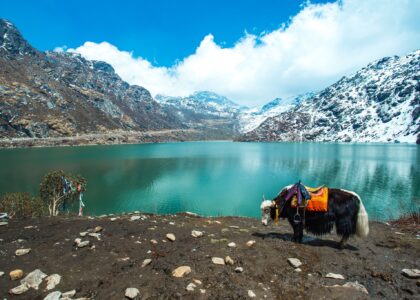
Locals call it Changu. You will call it unforgettable. Tsomgo Lake sits at over 12,000 feet, about 35 kilometres from Gangtok, and it changes colour with the seasons — deep blue in summer, half-frozen in winter, ringed by rhododendrons in spring. No single version of it is ordinary.
What makes Tsomgo romantic is not just the view — it is the effort it takes to get there. The road climbs steadily past army convoys and prayer flags, the air thinning as you go higher, until suddenly the lake appears in a bowl of mountains like something placed there deliberately. You will feel the altitude in your lungs and the beauty in your chest at the same time.
“Standing at Tsomgo in the early morning, when the mist hasn’t fully lifted and the water is still as glass, you understand why this lake is considered sacred. It feels like a place that doesn’t belong entirely to the world.”
Yak rides around the edge are available for couples who want a gentle, unhurried way to take in the scenery. In November through February, the lake partially freezes and the surrounding peaks are dusted with snow — a sight that feels genuinely cinematic. Wrap up well, hold hands, and just stand there for a while. That’s enough.
Pelling — The Town That Faces Kanchenjunga
West Sikkim · 7,200 ft above sea level
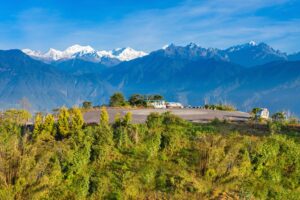
If you want to wake up to Kanchenjunga — the world’s third-highest peak — right outside your bedroom window, come to Pelling. This quiet hilltop town in West Sikkim is not flashy. There are no rooftop bars or crowded promenades. What it has is a view that, on clear mornings, will stop your conversation mid-sentence.
The Chenrezig statue that watches over the valley is a peaceful walk away. The Pemayangtse Monastery, one of Sikkim’s oldest, sits close by — its prayer rooms carrying the weight of centuries. Couples who visit often find themselves sitting quietly in the monastery courtyard long after they had planned to leave.
Pelling is also the starting point for the Sky Walk — a glass-floored suspension bridge — and the Rimbi Rock Garden, where waterfalls tumble through moss-covered boulders in the monsoon months. But the real reason to come here is the mountain. When clouds break and Kanchenjunga reveals itself at dawn, bathed in the first pink light of day, you will understand exactly why people keep coming back to this small, unhurried town.
Ravangla — Peace at the Heart of South Sikkim
South Sikkim · 7,000 ft above sea level
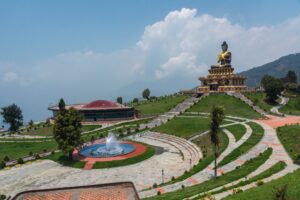
Ravangla is the kind of place that travel writers used to keep secret. It sits between Gangtok and Pelling — most people pass through it rather than stop — but those who do stop find a town so calm it almost feels like the world has agreed to slow down for a while.
The main draw is the Tathagata Tsal, commonly called Buddha Park, where a massive 130-foot statue of the Buddha sits on a terrace with the Himalayan range stretched out behind it. Walk here in the late afternoon when the light turns golden and the mountains shift between amber and purple. There is almost no noise. Couples who visit often describe a feeling of shared stillness that is difficult to find anywhere else.
The tea gardens below Ravangla — rolling green terraces dropping into the valley — are worth an hour of quiet walking. The Maenam Wildlife Sanctuary above the town offers forest trails through oak and rhododendron, with occasional glimpses of red pandas if you are patient and quiet.
“Ravangla doesn’t compete for your attention. It simply waits. And somehow that patience is exactly what makes it so lovely.”
Yuksom — Sikkim’s First Capital, Still Untouched
West Sikkim · 5,840 ft above sea level
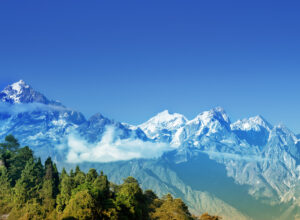
Yuksom was the first capital of Sikkim, established in the 17th century. Three hundred years later, it still feels like a place that has refused to hurry. There are no big hotels. No loud restaurants. What there is instead — ancient monasteries, mossy stone paths, a sacred coronation throne, and forests so quiet you can hear the wind moving individually through the trees.
Couples who come to Yuksom tend to stay longer than planned. The Dubdi Monastery, the oldest in Sikkim, sits above the town and requires a short walk through the forest to reach. That walk alone — through ferns and rhododendrons, past prayer wheels and mani walls — is one of the most quietly beautiful things you can do in this part of the world.
Kathok Lake, a small sacred lake surrounded by primeval forest, is a short trek from town. You will likely be alone there. The forest around it is so thick and so old that it has its own weather — cooler, darker, and smelling powerfully of earth and leaves. Sit at the lake edge for a while. It is the kind of place that asks nothing of you and gives everything.
Gangtok — City Lights and Mountain Mornings
East Sikkim · 5,500 ft above sea level
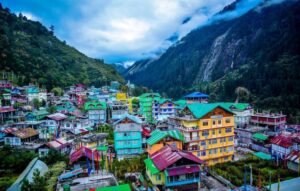
Gangtok city lights and hillside buildings at dusk, Sikkim
Gangtok is Sikkim’s capital and its most dynamic city — but even here, Sikkim’s gentle character shows through. The city sits on a ridge with mountain views on all sides. The famous MG Marg pedestrian street is where people come to eat, stroll, and watch the Himalayan evening light do extraordinary things to the skyline.
For couples, Gangtok works best as a base — a place to return to after longer journeys into the mountains. The Enchey Monastery above the city offers spectacular views at sunrise. Cable car rides over the forested valleys give a perspective on the landscape that changes the way you read a map. And the local restaurants along MG Marg serve warm bowls of thukpa and plates of momos that are exactly what you want after a long mountain day.
At night, Gangtok’s hillside buildings glow against the dark mountain backdrop — a sight that is genuinely beautiful and peculiarly romantic for a small Himalayan city. Rent a room with a view. Order tea. Watch the lights come on, one by one, across the ridge.
Zuluk — The Road That Loops Through the Clouds
East Sikkim · 10,000 ft above sea level
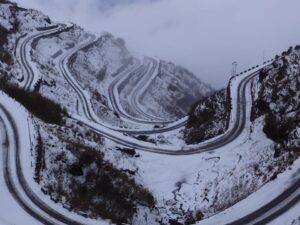
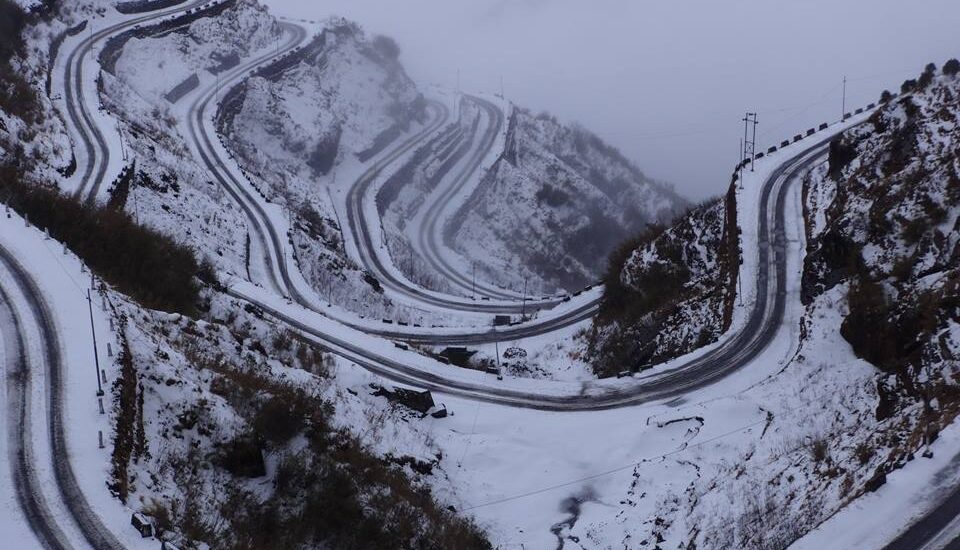
Zuluk is not easy to reach — and that is precisely why it belongs on this list. This old Silk Route hamlet in East Sikkim sits above 10,000 feet and is accessed by a road that loops through 32 hairpin bends before arriving at a landscape so starkly beautiful it seems impossible.
The valley below Zuluk is famous for the view of its zigzagging road from the mountain above — a sight that looks like something a landscape painter would invent, not discover. Early morning cloud seas roll through the valley between the peaks. Kanchenjunga appears on clear days. And the silence at this altitude is so complete that it takes some adjustment.
Zuluk is for couples who prefer adventure over comfort, and conversation over entertainment. There are basic homestays run by Sikkimese families — simple, warm, and generous with food. Staying with a local family, eating home-cooked meals by the fire, watching snow arrive or depart across the mountains — this is not a staged romantic experience. It is the real thing.
When Should You Go?
Every season in Sikkim has its own kind of romance. Here is what each one offers.
A Final Word
Sikkim does not have the infrastructure of Bali or the beach glamour of the Maldives. What it has is something harder to find and easier to keep — a kind of beauty that is not performing for you. The mountains are just there, enormous and indifferent. The monasteries have been praying for centuries. The rivers have been running since before anyone thought to name them.
When you travel through Sikkim as a couple, something shifts in the quality of your time together. There is less to distract you and more to actually see. The conversations get longer. The silences get more comfortable. By the time you leave, you will have shared something that is difficult to describe to people who weren’t there with you — which is perhaps the truest measure of a romantic journey.
Go in October if you want perfect skies. Go in March if you want flowers. Go in winter if you want the place entirely to yourselves. Just go.
Ready to Plan Your Sikkim Journey?
The mountains are waiting. Start with a call to a local Sikkim travel specialist who knows the permits, the roads, and the hidden places that never make it onto standard itineraries.x